
Practical Guide to Aptitude Tests: A General Overview of all Test Types
Table of Contents
Introduction
This page will walk you through the most common types of aptitude tests—complete with examples, solutions, and step-by-step explanations—used in the hiring processes of private companies and public institutions.
An aptitude test is a type of psychometric assessment used to measure a candidate’s cognitive abilities, specific skills, and behavioral traits. These tests are widely used, and today, nearly all employers include them as part of their selection process.
Start practicing now! Access our full question bank, sharpen your logical reasoning skills, and ace your next test.
100% Free. No Registration Required.
Types and Classifications
Logical Ability Categories
The most popular aptitude tests include verbal, spatial, cognitive, personality (which we’ll set aside for now as they deserve a separate section), and numerical tests. Their questions generally fall into the following categories of logical abilities:
- Verbal Reasoning: this involves the ability to understand, analyze, and draw conclusions from written texts or language expressions. It includes recognizing relationships between words, identifying analogies, interpreting implicit meanings, and assessing logical consistency.
- Numerical Reasoning: This refers to the ability to analyze and interpret numerical data, recognize mathematical patterns, solve quantitative problems, and draw conclusions based on numbers or sequences.
- Abstract Reasoning: this measures the ability to identify patterns and relationships among symbolic or intangible elements, often without a specific context. It includes recognizing sequences, visual analogies, or logical connections between symbols.
- Spatial Reasoning: this covers the ability to mentally visualize and manipulate objects in space. It involves imagining shapes, mentally rotating figures, and understanding relationships between three-dimensional forms.
- Mechanical Reasoning: focuses on understanding physical and mechanical principles such as forces, levers, gears, and motion. It is useful for solving practical problems related to the operation of machinery or physical objects.
- Mechanical Reasoning: involves the ability to interpret and draw conclusions from diagrams, charts, tables, or visual schemes. It requires understanding relationships represented visually.
- Critical Reasoning: involves evaluating and analyzing arguments or statements, identifying logical errors, fallacies, or inconsistencies, and making informed judgments based on evidence.
100% Free. No Registration Required.
Types of Psychometric Aptitude Tests
There are many companies specializing in the development of aptitude tests. Some of the most prominent global providers include SHL, Korn Ferry, Kenexa, Talent Q, and Pearson, among others. However, the tests they produce generally fall into the following categories:
This classification covers a wide range of cognitive and aptitude-related abilities, allowing for the assessment of specific skills such as analytical thinking, critical reasoning, the understanding of complex patterns, and the practical application of theoretical knowledge.
Each type of test is designed to fit different contexts—such as recruitment, academic assessments, or professional certifications—and provides reliable tools to identify the potential and competencies of candidates and students.
For this reason, understanding these categories enables more targeted preparation, significantly increasing the chances of success.
Aptitude Question Categories
Here is a summary, based on a review of the literature, of the various types of questions commonly used to assess cognitive and aptitude-related skills through psychometric tests administered by companies, consulting firms, public institutions, and universities:
- Image Analogies
- Arithmetic Calculations
- Basic and Advanced Math Skills
- Logical Deductions
- Odd One Out
- Inductions
- Image Matrices
- Meta Multiple-Choice Questions
- Ordering/Ranking Tasks
- Word Problems (Story-Based)
- Explicit Multiple Choice
- Implicit Multiple Choice
- Image Sequences
- Number Series
- Syllogisms
- Tables and Charts
- True – False – Cannot Say
- Verbal Reasoning
- Levers, Pulleys, Gears
- Process Flows, Concept Maps
- Vocabulary
- Word Analogies
The question categories listed above represent a diverse range of exercises designed to stimulate and assess different cognitive areas—from logical-analytical reasoning to verbal and numerical comprehension, as well as the ability to solve practical and situational problems.
This wide variety ensures that the tests are suitable for multiple contexts and candidate profiles, offering a comprehensive evaluation of an individual’s cognitive and aptitude-related abilities.
Preparing for each category not only helps improve your skills but also gives you a clear, objective understanding of your strengths and areas for improvement.
100% Free. No Registration Required.
Sample Questions and Answers
Image Analogies
- Question 1 with solution
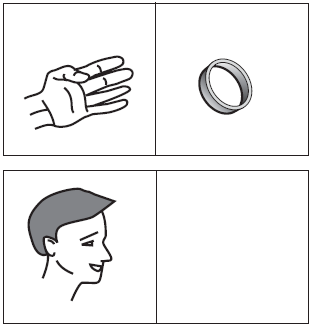
Which of the following options correctly completes the analogy?
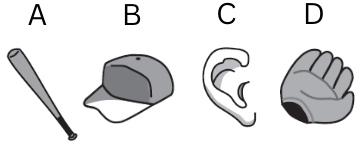
- Question 2 with solution

Which of the following options correctly completes the analogy?
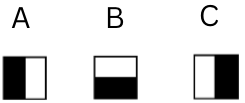
100% Free. No Registration Required.
Arithmetic Calculations
Arithmetic operations are the foundation of any math question and appear in almost every numerical aptitude test. They mainly include: addition, subtraction, multiplication, division, fractions, powers, roots, and radicals.
- Question 1 with solution (no calculator allowed)
4186 / 0.001 = ?
A) 4186000
B) 41860
C) 41.86
D) 418600
E) 4.186
- Question 2 with solution (no calculator allowed)
Convert 0.11111111 into a fraction.
A) 1/10
B) 1/11
C) 11/100
D) 1/9
E) 101/1000
100% Free. No Registration Required.
Math Skills
Beyond basic arithmetic, these questions may include: ratios, percentages, averages, unit and currency conversions, and geometry.
- Question 1 with solution
Due to a VAT increase on electronic devices, the price of a 46-inch LED TV has risen to $845—30% more than the original price. What was the TV’s price before the increase?
A) $515.45
B) $591.50
C) $650
D) $676
E) $768.95
- Question 2 with solution
Mark and Sarah are passionate car collectors. All the cars they own are either German-made or Japanese-made. In Mark’s collection, the ratio of German to Japanese cars is 5:2 in favor of German. In Sarah’s collection, the ratio is 4:3, also in favor of German cars. The number of Japanese cars in each collection is exactly the same. What is the ratio between the total number of cars (German + Japanese) in Mark’s collection and the total number in Sarah’s?
A) 15:8
B) 9:7
C) 1:1
D) 3:2
100% Free. No Registration Required.
Logical Deductions
Deductive reasoning involves using logic to derive specific conclusions from general rules. It requires identifying particular cases based on broad principles. Deductive reasoning is the opposite of inductive reasoning.
- Question 1 with solution
“If someone scolds Michael, he gets offended. But if no one scolds Michael, Umberto gets upset. Yesterday, Michael was not offended.” If all the above statements are true, what can we logically conclude about yesterday?
A) Michael wasn’t scolded, and Umberto didn’t get upset
B) Michael was scolded, and Umberto got upset
C) Umberto got upset
D) Michael was scolded, and Umberto didn’t get upset
E) Michael wasn’t offended, but he still might have been scolded
- Question 2 with solution
There are two types of reasoning: deductive and inductive. How many of the following arguments are DEDUCTIVE?
Argument 1:
Those who think they can judge others are foolish; Manuela constantly judges her friends; we can’t say that Manuela is intelligent.
Argument 2:
All the dogs I’ve owned had a great sense of smell; Cetto, my grandfather’s dog, is an excellent truffle hunter; Sibilla, my aunt’s poodle, always finds the candy hidden in the yard; dogs have an amazing sense of smell.
Argument 3:
I bet on ten and lost; I bet on thirty and lost; I bet on two and lost; I’m unlucky when it comes to gambling.
Argument 4:
Anyone preparing to visit a foreign country should also study its customs and traditions; Michele, who has been preparing for his trip to Indonesia for two months, should make sure to learn about local table manners.
A) All of them
B) Three
C) Two
D) One
E) None
100% Free. No Registration Required.
Find the Odd One Out
In a given set of information—such as a group of words, images, or statements—there is one element that does not belong with the others.
- Question 1 with solution
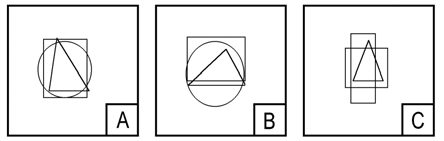
Which of the figures A, B, or C should be eliminated as it doesn’t belong to the group?
A) Figure A
B) Figure B
C) Figure C
- Question 2 with solution
Find the odd word out:
A) Actor
B) Author
C) Action
100% Free. No Registration Required.
Inductive Reasoning
Inductive reasoning involves drawing logical conclusions based on specific observations or cases, aiming to infer a general rule. This type of reasoning is the opposite of deductive reasoning, which starts from a general rule to reach a specific conclusion.
- Question 1 with solution
There are two types of reasoning: inductive and deductive. How many of the following reasoning examples are INDUCTIVE?
Reasoning 1: Emily and Daniel are medical students. Emily enjoys playing soccer. Daniel enjoys playing soccer. Therefore, all medical students enjoy playing soccer.
Reasoning 2: True love is shown through actions, not just words. John only declares his love to Julia with words. Therefore, Julia cannot rely on John’s love.
Reasoning 3: All the Brazilian women I’ve met have been charming. This summer I met Clara on vacation, a very charming Brazilian woman. Therefore, all Brazilian women are charming.
Reasoning 4: Beta-carotene helps achieve a perfect tan. Daniel takes a beta-carotene pill every morning. Therefore, by the end of the summer, Daniel will have the best tan.
A) All of them
B) Three
C) One
D) Two
100% Free. No Registration Required.
Image Matrices
- Question 1 with solution
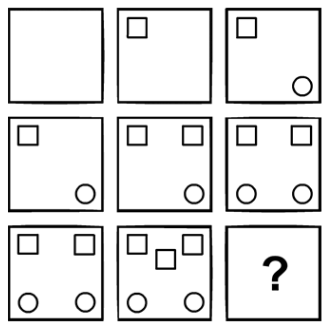
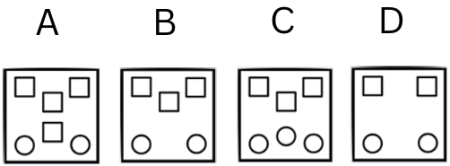
Choose the option that completes the image matrix:
- Question 2 with solution
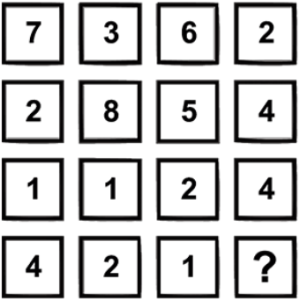
Which of the following options completes the matrix?
A) The answer is 1
B) The answer is 7
C) The answer is 4
D) The answer is 2
100% Free. No Registration Required.
Meta-level Multiple Choice Questions
Meta-level questions don’t focus on specific details from the text, but instead ask broader or “higher-level” questions about the text’s purpose or function. These questions often sound like: “What can be concluded from…?”, “What is the author’s intention…?”, “Which statement would weaken the author’s argument?”, or “What is the main point of the passage?”
Read the passage and try to answer the following questions:
Until recently, the village of Ramdegi was a thriving farming community in the heart of India’s renowned Tiger Reserve. Today, its human population is exactly zero. As part of an effort to reduce conflicts between humans and wildlife, the Indian government has encouraged communities living in and around nature reserves to relocate, promoting peaceful coexistence. Last month, everyone in Ramdegi did just that: about 200 families accepted government incentives and moved beyond the reserve’s boundaries, leaving the land to be reclaimed by surrounding biodiversity.
Just over a month after the last human fatality due to wildlife attacks, Ramdegi is now home to herds of deer, antelope, and wild boar, grazing in meadows that were once used for farming and cattle grazing. A tiger has even been spotted roaming the now-abandoned village, free from the dangerous and often deadly encounters with humans that have long threatened its species.
- Question 1 with solution
Which of the following is an assumption made by the author in the second paragraph?
A) Humans can be violent toward animals
B) Tigers are quiet animals
C) Tigers usually kill humans
D) Humans are respectful of wildlife
100% Free. No Registration Required.
Ordering Problems
- Question 1 with solution
On a certain planet, there are three people: Andrew, Mark, and John. There is one person on the planet who is richer than everyone else. Mark is richer than Andrew. Andrew is poorer than John. Which of the following conclusions is definitely FALSE?
A) Andrew is the poorest
B) John is the richest
C) John is poorer than Mark
D) Mark and John have the same amount of money
E) Mark is the richest
100% Free. No Registration Required.
Word Problems
A word problem consists of a few sentences that describe a scenario in which a problem must be solved using mathematical reasoning.
These problems vary in difficulty and type, with some of the most common involving work or travel scenarios that require algebraic expressions. Word problems frequently appear in tests such as CCAT, PI Cognitive Assessment, McQuaig Mental Agility Test (MMAT), Logik Cubiks.
- Question 1 with solution
A post office receives one package every 3 minutes, and the mail carrier delivers 12 packages per hour. If the carrier starts work at 8:00 AM and there were no leftover packages from the day before, how long will it take before exactly 100 packages have accumulated at the post office?
A) 50 minutes
B) 3 hours and 20 minutes
C) 6 hours and 40 minutes
D) 10 hours and 50 minutes
E) 12 hours and 30 minutes
- Question 2 with solution
Chiara and her parents are walking down the street. Her parents are walking at a pace of 80 steps per minute. Her father is 12 steps ahead of her mother. Chiara is walking behind them at a pace of 90 steps per minute. All family members have the same average step length. How many seconds would pass between the moment Chiara catches up to her mother and the moment she catches up to her father?
A) 8 seconds
B) 12 seconds
C) 28 seconds
D) 72 seconds
E) 82 seconds
100% Free. No Registration Required.
Multiple Choice - Explicit
Explicit multiple-choice questions are those where the correct answer is directly stated in the text. These typically include questions like “In what year…?”, “How many…?”, or “Which are…?”
Read the passage and try to answer the following questions:
Menai Bay is a protected area in the southwest of Zanzibar, Africa. It is home to a wide variety of marine life, including birds, fish, and dolphins (such as bottlenose dolphins and humpback dolphins). Two species of whales are also present during the June-to-November season. Dolphins—especially the friendly bottlenose dolphins that are present year-round—have become a major tourist attraction. Tourists head out on fishing boats to see the dolphins, which often jump in the water and swim alongside them. While dolphins are friendly with tourists, they are sometimes surrounded and chased by as many as 20 boats at once, which can cause them stress—especially when they are feeding or nursing. Therefore, the main goal of the African Marine Conservation Project is to monitor dolphins and human-dolphin interaction.
- Question 1 with solution
Which of the following statements is NOT true about the dolphins?
A) They are present all year round
B) They are particularly friendly when being fed
C) They are friendly with tourists
D) They can be found in Zanzibar
100% Free. No Registration Required.
Multiple Choice - Implicit
In this type of question, the answer isn’t stated directly in the text but can be inferred from the information provided. Examples include: “Why did the manager decide to…?” or “What could be the reason for…?”
Read the passage and try to answer the following questions:
Veganism is a type of vegetarian diet that excludes meat, eggs, dairy, and all other animal-derived ingredients. Many vegans also avoid foods processed using animal products, such as refined white sugar and certain wines. Most vegans also refrain from using any items tested on animals, as well as non-food products made from animals, such as leather, fur, and wool. A vegan diet includes all types of grains, beans, legumes, vegetables, fruits, and the nearly endless variety of dishes that can be created by combining them. Many vegan versions of common foods are available, so you can enjoy vegan hot dogs, ice cream, cheese, and mayonnaise. Although there’s some debate about whether certain foods like honey fit into a vegan diet, if you’re cooking for other vegans, it’s best to play it safe and avoid them.
- Question 1 with solution
Based on the passage, which of the following statements is definitely true?
A) Vegans do not eat honey
B) Some vegans eat honey
C) There is a vegan version of honey
D) There is no vegan version of honey
100% Free. No Registration Required.
Image Series
The following exercises present a logical sequence of five images. Your task is to determine which option completes the sequence. Choose your answer from the options labeled A, B, C, D, or E.
- Question 1 with solution
Which image completes the sequence?

Choose the correct answer.

- Question 2 with solution
Which image completes the sequence?

Choose the correct answer.

100% Free. No Registration Required.
Number Series
Number series questions present sequences of numbers, known as “terms,” which follow logical arithmetic rules.
Your task is to identify the missing number in the sequence. The difficulty level tends to increase as the patterns become less obvious, requiring careful attention and creativity.
These types of questions appear in the following numerical reasoning tests: CCAT, PI Cognitive Assessment, McQuaig Mental Agility Test (MMAT), Logik Cubiks.
- Question 1 with solution
3 | 8 | 15 | 24 | 35 | ?
A) 42
B) 36
C) 48
D) 46
- Question 2 with solution
3 | 3 | 3 | 6 | 3 | 9 | 3 | ?
A) 3
B) 27
C) 12
D) 6
100% Free. No Registration Required.
Syllogisms
- Question 1 with solution
Given the following statements: “If Mario is in Rome, then Piero is in Milan. Therefore, Piero is in Milan.” Which of the following statements is true?
A) Mario is in Rome
B) No logically valid conclusion can be drawn
C) Piero is in Milan
- Question 2 with solution
If the statement “Not all misfortunes come to harm” is true, which of the following must also be true?
A) Some misfortunes do not come to harm
B) Misfortunes do not cause harm
C) Those that cause harm are not misfortunes
100% Free. No Registration Required.
Tables and Charts

- Question 1 with solution
Looking at the chart above showing the amount spent on computer imports, how much more did Germany spend than Italy in Year 3?
A) 650 million
B) 700 million
C) 750 million
D) 800 million
E) 850 million
- Question 2 with solution
Looking at the chart above showing the amount spent on computer imports, if the amount spent by the United Kingdom in Year 5 was 20% less than in Year 4, how much was spent in Year 5?
A) 1,080 million
B) 1,120 million
C) 1,160 million
D) 1,220 million
E) 1,300 million
100% Free. No Registration Required.
True – False – Cannot Say
This type of verbal reasoning question presents you with a passage of text followed by a statement. You must then determine, based solely on the text, whether the statement is:
- True – Use this when the statement can be logically deduced from the information given in the passage;
- False – Use this when the statement contradicts information in the passage;
- Cannot Say – Use this when the passage does not provide enough information to determine whether the statement is true or false.
Read the passage and answer the following questions:
Even though the minimum age for obtaining a driver’s license will increase in the coming years, the projected sharp rise in car sales is expected to lead to a dramatic increase in the number of fatal road accidents. As shown by the latest data, fatal car crashes are especially common among younger drivers with less than five years of driving experience. Last winter, 50% of all fatal road accidents involved drivers with no more than five years of experience, and an additional 15% involved drivers with between six and eight years of experience. Preliminary data from this year shows that the anti-accident awareness campaign has had some positive effect, but the truth remains that the number of young drivers involved in fatal accidents is still intolerably high.
- Question 1 with solution
Fatal car accidents are more common among young drivers with six to eight years of experience than among older drivers with similar experience.
A) True
B) False
C) Cannot Say
- Question 2 with solution
The sharp increase in car sales will be the cause of the sharp increase in fatal road accidents.
A) True
B) False
C) Cannot Say
100% Free. No Registration Required.
Verbal Reasoning
Read the following passage and answer the questions:
“Many organizations find it beneficial to hire students during the summer. Permanent staff typically prefer to take their vacations during this time. It’s also not uncommon for companies to experience peak workloads in the summer and therefore require additional staff. Summer jobs are appealing to students, who may later return to an organization as qualified candidates after completing their studies. By ensuring students learn as much as possible during their time there, organizations aim to encourage their interest in returning as permanent employees. Students are paid a fixed amount, without the usual entitlement to paid holidays or sick leave.”
- Question 1 with solution
The statement “Permanent staff on vacation can be replaced by students” is…
A) True
B) False
C) Cannot Say
- Question 2 with solution
The statement “Students employed in the summer are offered the same paid vacation as permanent staff” is…
A) True
B) False
C) Cannot Say
- Question 3 with solution
The statement “Students are subject to the organization’s standard disciplinary and grievance procedures” is…
A) True
B) False
C) Cannot Say
100% Free. No Registration Required.
Levers, Pulleys, Gears
Mechanical reasoning tests are commonly used in the hiring process for technical and engineering roles. These assessments measure how well you can apply principles of mechanics to solve practical problems.
Whether you’re applying for an entry-level position or a more advanced role, these tests can be tough—especially under strict time limits. That’s why practicing in advance is key: it helps boost both your speed and your accuracy.
You’ll be asked to work through a variety of physics-based scenarios involving concepts like force, motion, gravity, friction, pressure, energy (both kinetic and potential), and mechanical work and power.
- Question 1 with solution
Which of the two poles supports more of the rectangle’s weight?

A) Pole #1
B) Pole #2
C) Cannot Say
100% Free. No Registration Required.
Process Flows, Concept Maps
Mechanical reasoning tests are commonly used in the hiring process for technical and engineering roles. These assessments measure how well you can apply principles of mechanics to solve practical problems.
Whether you’re applying for an entry-level position or a more advanced role, these tests can be tough—especially under strict time limits. That’s why practicing in advance is key: it helps boost both your speed and your accuracy.
You’ll be asked to work through a variety of physics-based scenarios involving concepts like force, motion, gravity, friction, pressure, energy (both kinetic and potential), and mechanical work and power.
- Question 1 with solution
A company manufactures three types of products: A, B, and C. The production process consists of four sequential stages: Preparation → Assembly → Quality Control → Packaging. Each product takes a different amount of time to complete each stage, as shown below (in minutes per unit):

Today, the factory plans to produce 2 units of each product.
Question:
What is the total amount of time (in minutes) needed to complete the entire production process, assuming that each stage must be fully completed for all units before the next stage can begin?
A) 132 minutes
B) 144 minutes
C) 156 minutes
D) 168 minutes
E) 180 minutes
100% Free. No Registration Required.
Vocabulary
Vocabulary questions measure your understanding of word meanings, including synonyms, antonyms, and words used in context. These questions typically present a single word and ask you to select the option that is closest in meaning. In some cases, you may also be asked to identify a word with the opposite meaning (an antonym), or to infer the meaning of a less common word based on its root or prefix.
This type of question evaluates your verbal fluency and reading comprehension—skills that are closely tied to both academic success and workplace communication. A strong vocabulary helps you understand nuanced meaning, follow complex instructions, and express ideas precisely. These questions often appear in assessments such as the GRE, SAT, and various employment aptitude tests.
To perform well, it’s helpful to be familiar with common word roots (Latin and Greek), prefixes, and suffixes. Reading widely—especially non-fiction and academic texts—can also improve your vocabulary naturally over time.
- Question 1 with solution
Which word is closest in meaning to elated?
A) anxious
B) confused
C) thrilled
D) indifferent
E) bored
Word Analogies
Word analogy questions assess your ability to recognize logical relationships between pairs of words. Each question presents a word pair with a specific connection (such as cause and effect, part to whole, item to category, or function), and asks you to choose the pair among the answer choices that best reflects the same kind of relationship.
For example, the analogy fire : heat describes a cause-effect relationship—fire causes heat. The correct answer would be another pair that mirrors that same relationship.
These questions test more than just vocabulary—they also require abstract thinking, attention to logical structure, and the ability to distinguish subtle differences in meaning. Word analogies are a classic component of IQ tests, standardized exams like the GRE, and many cognitive ability assessments used in hiring processes.
A useful strategy is to first define the relationship between the first pair in a simple sentence (e.g., “A is used to make B” or “A is a type of B”), and then look for the answer pair that fits the same sentence.
- Question 1 with solution
BIRD is to NEST as:
A) fish is to water
B) lion is to roar
C) bee is to hive
D) tree is to leaf
E) spider is to web
100% Free. No Registration Required.